
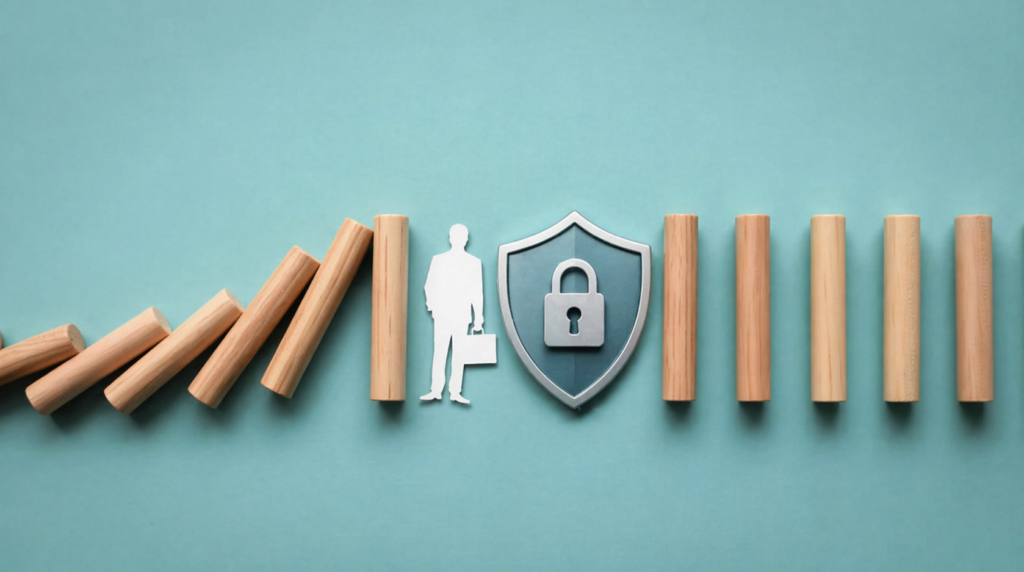
Think about how you secure your home.
You probably do not rely on a single deadbolt and call it done. You have locks on the windows. Maybe a security system. Exterior lighting. A dog that barks at strangers. Each of those things adds a layer of protection, and each layer covers for the weaknesses of the others. If someone gets past the front door, the alarm goes off. If the alarm fails, the dog wakes up.
That is layered security. And most businesses are not applying that same logic to their IT environments.
Instead, they buy a firewall and consider the job done. They install antivirus software and move on. They put all of their trust in a single line of defense, and then discover, usually at the worst possible moment, that a determined attacker only needs to find one gap to get through.
The Single Lock Problem
Here is what a single-point security strategy looks like in practice.
A Calgary construction firm has a solid firewall in place. Their email runs through a basic spam filter. Staff completed a security awareness training session last year. On paper, they are protected.
Then an attacker bypasses the firewall through an unpatched remote access tool that has not been updated since 2022. The spam filter misses a sophisticated AI-generated phishing email because it looks exactly like a message from one of their material suppliers. A staff member clicks the link. Credentials are stolen. The attacker is inside the network.
At every step, the business had a defense. At every step, the attacker found the gap around it. Because when defenses do not overlap, the gaps between them are exactly where attacks succeed.
As Cloudflare explains in their defense-in-depth overview, using only one security product creates a single point of failure. If that product is compromised, the entire network can be breached as a result. The goal of layered security is to ensure no single failure ever gives an attacker a clear path through.
The Six Layers in Layered Defense
Layered security is not about buying more tools. It is about building overlapping defenses so that when one layer is tested, another is ready to catch what gets through. Here is what that looks like in practice for a Calgary business between 25 and 250 employees.
The Perimeter Layer. Your firewall and network controls are the front door. They block known threats and manage traffic in and out of your environment. This is where most businesses start, and where most businesses stop. It is necessary but nowhere near sufficient on its own.
The Endpoint Layer. Every laptop, desktop, phone, and remote device accessing your systems is a potential entry point. Endpoint detection and response tools monitor behavior on those devices continuously, looking for activity that signals a threat even when no known malware signature is present.
The Identity Layer. Most breaches in 2026 do not start with someone hacking through a firewall. They start with stolen credentials. Multi-factor authentication, access controls, and least-privilege permissions ensure that stolen credentials alone are not enough to move freely through your systems.
The Email Layer. Email remains the most common entry point for attacks. Advanced filtering, link scanning, and sender verification go beyond basic spam filters to catch the AI-generated, highly personalized attacks that traditional tools miss.
The Monitoring Layer. All of the above generates data. That data is only useful if someone is watching it, interpreting it, and responding to it in real time. Continuous monitoring by people who know what they are looking for is what converts tools into actual security operations.
The Response Layer. When something gets through, and at some point something will, your incident response plan determines how fast you contain it and how much damage it causes. A documented, tested plan is what separates a contained incident from a business-disrupting crisis.
Your Clients Are Already Asking. Do You Have an Answer?
For Calgary businesses in financial services, oil and gas, construction, and professional services, layered security is not just a best practice. It is increasingly a business requirement.
76% of cyber insurance claims in 2024 originated as phishing attempts, making email security and employee training critical layers that many businesses still treat as optional. Insurers are tightening their requirements around exactly these controls, and businesses that cannot demonstrate layered defenses are finding themselves either paying significantly higher premiums or facing claim denials when they need coverage most.
Beyond insurance, clients and partners in regulated industries are increasingly asking their vendors and service providers to demonstrate their security posture before signing contracts or sharing sensitive data. A layered security strategy is not just protection against attackers. It is documented proof that your business takes this seriously.
What Would Happen If You Got Breached?
Most Calgary business leaders assume their security is solid because they have never had a serious incident. That is understandable. It is also the wrong benchmark.
The absence of a known breach does not mean your defenses are strong. It may mean you have been fortunate, or that an attacker has been inside your environment longer than you realize without triggering anything obvious. The average time to identify a breach remains measured in months, not days.
The right question is not "have we been breached?" It is "if an attacker got past our first layer right now, what would stop them next?"
If the honest answer is "I am not sure," that is exactly the information you need. And it is the kind of question that deserves a straight answer from a team that will give you one without the pressure or the jargon.
Register here for our upcoming webinar: Learn how Calgary businesses are moving from reactive IT to resilient infrastructure that performs under pressure. This 30-minute session is on April 28th at 11:00AM (Mountain).
Can’t wait until April 28?
Schedule a complimentary consultation with Alex McGillivray.