
"Co-managed" gets thrown around a lot, but most business owners have never seen how it really works day to day. For Sure Systems founder Alex McGillivray, the concept is simple: it's not choosing between your internal IT person and an outside provider. It's both, working from the same playbook.
It's Not All-or-Nothing
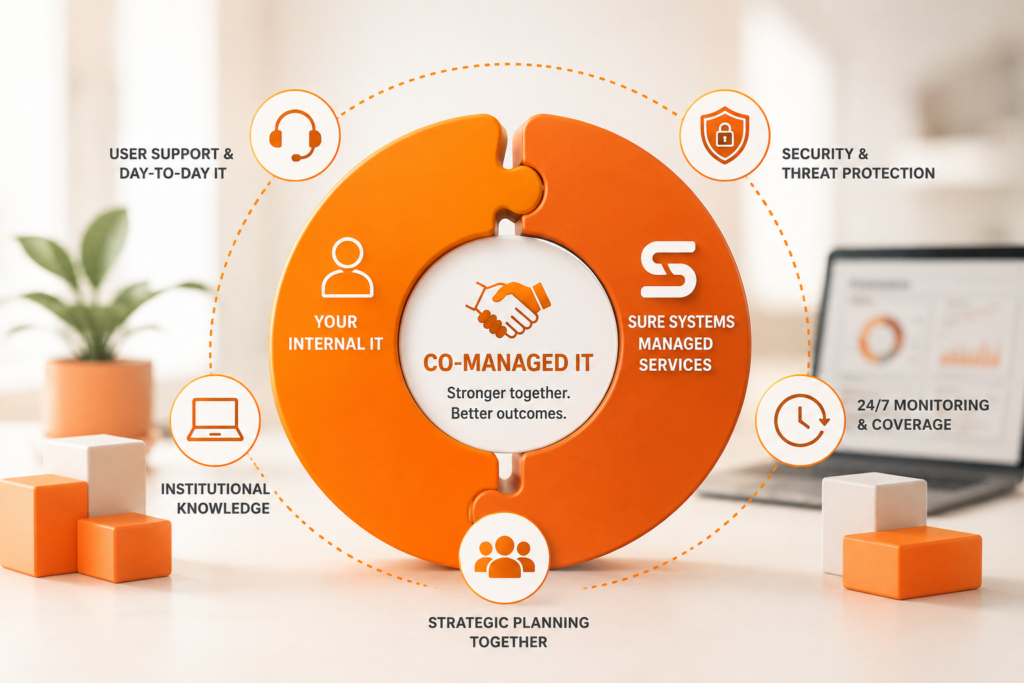
A lot of business owners assume the choice is binary: keep your internal hire and go it alone, or replace them with a managed provider. That framing misses the point entirely. Co-managed IT means your internal person keeps the institutional knowledge, the day-to-day relationships, and the context only they have. A managed partner adds the depth and specialization one person can't reasonably cover alone.
What Gets Divided, and What Doesn't
In a well-run co-managed setup, responsibilities are split based on where each side is strongest:
- Your internal IT person handles day-to-day user support, vendor relationships, and institutional knowledge
- The managed partner covers after-hours monitoring, specialized security work, and coverage during vacations or turnover
- Strategic planning happens together, combining internal context with outside expertise
More than half of businesses that outsource technology work now do so on a regular or frequent basis, according to CompTIA's industry research, reflecting how normal this blended approach has become, even for companies with existing internal IT staff.
Why This Model Works Better Than Either Extreme
Going it alone with one internal hire creates a single point of failure. Fully outsourcing everything can mean losing the institutional knowledge only an internal person has. Co-managed IT solves both problems by keeping continuity where it matters and adding coverage where it's thin, particularly around cybersecurity, where specialized skill matters most. Following small business cyber security guidelines from Canada's federal cyber authority gives both sides of a co-managed team a shared, prioritized starting point instead of guessing at what to tackle first.
Reinforcement Is the Whole Point
Mutual Success, one of Sure Systems' four core values, is what shapes how a co-managed relationship gets built in the first place. There's no default package. The starting point is always an honest look at what your internal team already handles well, and where the real gaps are. "I'd rather tell somebody to fix a workable relationship than force a needless transition," McGillivray says, and that same logic applies here: the goal is reinforcing a good internal setup, not replacing it.
Ready to See What Co-Managed IT Could Look Like for Your Team?
A second set of eyes on your current setup costs nothing to start.
Talk to Sure Systems today about building a co-managed plan around your existing team.
Frequently Asked Questions
Will our internal IT person feel replaced by a co-managed setup? No, when it's built correctly. The internal hire keeps ownership of day-to-day relationships and institutional knowledge. The managed partner fills specific, defined gaps.
How do you decide who handles what? It starts with an honest assessment of your current environment, your internal person's strengths, and where coverage is thin.
Is co-managed IT only for businesses with one internal IT person? No. It works well for small internal teams too, especially when specialized coverage like cybersecurity or after-hours monitoring is stretched thin.
Watch This To Learn More
You can also hear from Alex McGillivray in this quick video, "Client Trust Starts With Great IT"