
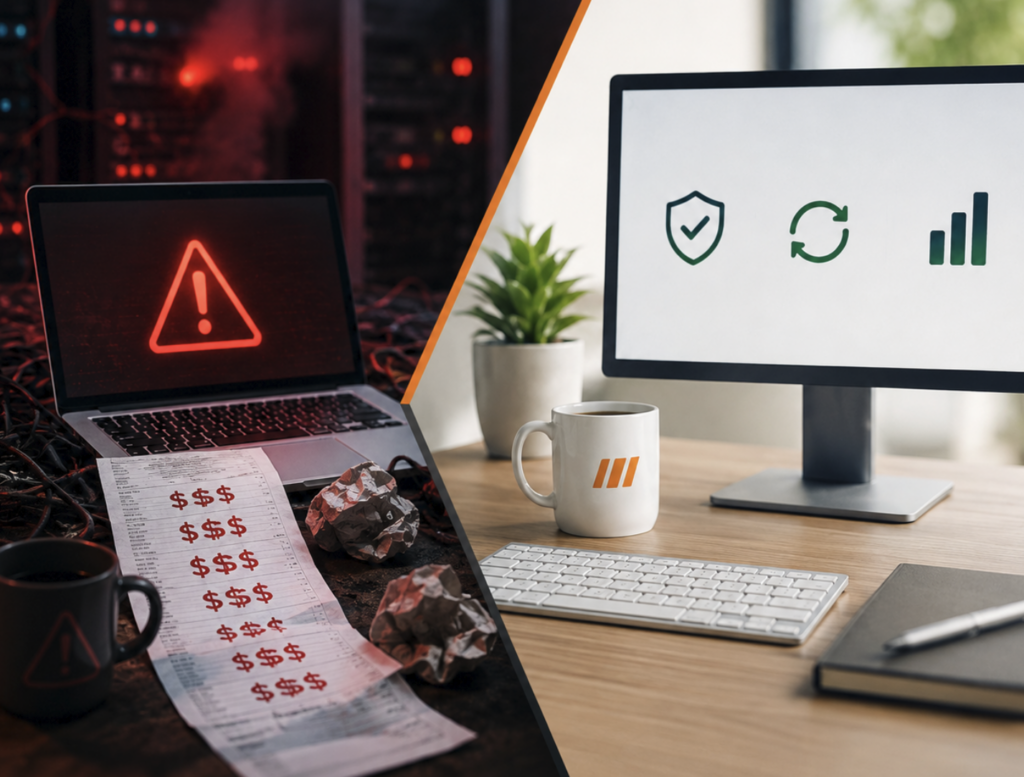
Every reactive IT quote looks like a deal, right up until something breaks. Alex McGillivray, founder of Sure Systems, has seen this pattern for over 21 years: "Cheap IT is usually the most expensive IT, because it hides real costs until the business is already paying for them." The savings you see upfront rarely account for what happens when your systems go down and nobody planned for it.
Reactive Quotes Leave Out the Expensive Part
A low quote often means a narrower scope. Cybersecurity monitoring, patch management, and backup verification are the first things to get trimmed, because they're invisible until the day you need them. "Cheap quotes leave out the very things that prevent expensive problems," McGillivray says. You don't notice what's missing until you're already in the middle of an outage or a breach.
What Downtime Really Costs You
Research from the Uptime Institute's 2024 Annual Outage Analysis found that over half of significant outages cost organizations more than $100,000, and one in five topped $1 million. Those figures include lost revenue, recovery labor, and the productivity drain while your team gets back up to speed, costs a reactive-only IT plan almost never accounts for in advance.
The Hidden Cost of "Wait and See"
Reactive IT means your provider shows up after something has already failed. That reactive posture costs you in a few specific ways:
- Emergency labor rates instead of planned maintenance pricing
- Lost staff productivity while systems are down
- Rushed decisions made under pressure instead of a plan built in advance
- Compounding risk, since one unresolved issue often creates the conditions for the next one
Proactive Support Changes the Math
The alternative isn't more expensive line items. It's catching small problems before they become expensive ones. Government guidance like the Get Cyber Safe small business guide lays out exactly why prevention costs less than recovery: patched systems, monitored networks, and tested backups all cost a fraction of what a breach or outage does after the fact.
What Makes Sure Systems Different
Excellence, one of Sure Systems' four core values, shows up here in a very specific way: transparent pricing that doesn't quietly cut corners. McGillivray is direct about what that means for prospective clients who are shopping on price alone. "If a prospect wants the cheapest possible vendor and sees IT as a commodity, we're probably not aligned, and that's okay. I'd rather be honest early." Every quote from Sure Systems accounts for the full picture, so there's no invisible gap waiting to surface later.
Ready to See the Full Picture?
Don't wait for a hidden cost to show up as an emergency invoice.
Talk to Sure Systems today and understand what your IT is really covering before an incident.
Frequently Asked Questions
How do I know if my current IT quote is missing something? Ask specifically what's included for security monitoring, patching, and backup testing. If the answer is vague, or those items are priced as extras, you likely have a reactive-only plan.
Is proactive IT support always more expensive month to month? Not necessarily. It's often comparable to a reactive plan on a monthly basis, the difference shows up in what you avoid, not what you pay upfront.
What's the first sign my business is paying the hidden cost of reactive IT? Frequent "emergency" invoices are the clearest signal. If most of your IT spending happens after something breaks, you're paying the reactive premium already.
Watch This To Learn More
You can also hear from Alex McGillivray as he explains why "Cheap IT Is Never Cheap" in this quick video.